C. S. Lewis’s mother’s death
Surprised by JoyC. S. Lewis’s mother’s death was the decisive rupture in his childhood: after a prolonged illness and a frightened child’s hope for her recovery, the family lost its settled happiness and Lewis and his brother drew together while becoming estranged from their father. The memoir presents the death not as a single moment alone but as a change in the household, in the boys’ loyalties, and in Lewis’s sense of what prayer could accomplish.
Illness and the family’s loss
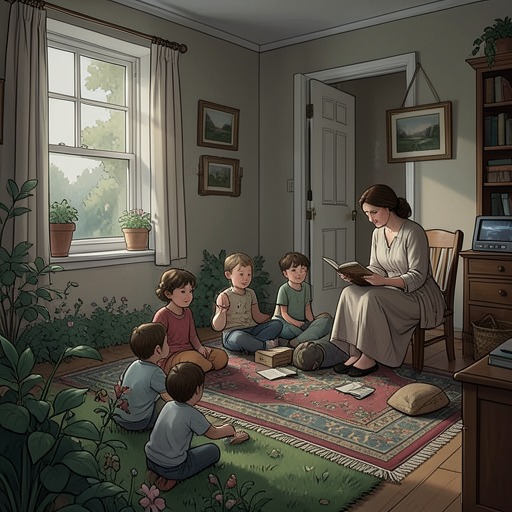
Lewis recalls being ill with headache and toothache on a night when his mother did not come to him. She was ill herself; doctors were in her room, and voices, footsteps, and doors opening and shutting carried through the house for hours. His father eventually entered in tears and tried to explain something the child could scarcely conceive: his mother had cancer. The illness followed what Lewis calls its usual course: an operation in the patient’s home, an apparent recovery, the disease’s return, increasing pain, and death. His father, Lewis writes, never fully recovered from the loss.
In retrospect, Lewis cannot be certain whether the episodes of Joy he has just described occurred before or after this bereavement. That uncertainty does not soften the loss’s place in the account: he identifies his mother’s death as the boundary beyond which the old security did not return. He distinguishes the boys’ experience from adult grief, locating their bereavement earlier than the death itself, in the gradual withdrawal of their mother from family life into the care of nurses and the effects of delirium and morphia.
A household transformed
The illness made the familiar house alien and threatening. Lewis remembers strange smells, noises in the night, and whispered conversations; the boys watched their mother disappear from their daily world before she died. The crisis also divided the children from their father. Lewis reflects that a shared sorrow does not necessarily draw together people of widely different ages: the spectacle of adult misery and fear left the boys paralyzed and alienated rather than able to comfort him.
His father’s anxiety, Lewis says, exposed unstable nerves and uncontrolled emotions. Under pressure, his temper became unpredictable, and he sometimes spoke wildly and acted unjustly. Lewis does not present this as a simple accusation: he wonders whether the boys might have eased their father’s suffering had they been better children, while acknowledging that they did not. The consequence was a painful estrangement at the very moment the family had suffered its central loss.
Against that separation, Lewis and his brother increasingly relied on one another. They came to trust each other and, Lewis suspects, to lie to their father. As everything that had made the house a home seemed to fail, their closeness became the one remaining source of comfort: two frightened boys huddled together in a bleak world. The loss thus both fractured the family and intensified the brothers’ bond.
Death, mourning, and prayer
Lewis was taken to the bedroom where his mother lay dead, ostensibly to see her. He understood that he was being made to see the dead body, and terror overwhelmed grief. He rejects the adult language that calls the dead beautiful: to the child, death itself was a total disfigurement. The coffin, flowers, hearse, and funeral brought further horror. He even rebuked his aunt, Aunt Annie, over mourning clothes, an act he later connects to a lasting distaste for public and collective forms and an awkwardness with formality.
The illness also prompted an early, unsuccessful experiment in religious belief. Remembering the teaching that prayers offered in faith would be granted, Lewis tried by willpower to believe that his mother would recover. When she died, he shifted to the expectation of a miracle. Its failure did not produce a religious crisis. Looking back, he explains that the faith he had forced upon himself treated God as a magician summoned to restore things to their former state, not as a Savior or Judge whose presence might carry consequences beyond the requested cure. The episode therefore exposed the limits of a child’s transactional idea of prayer rather than establishing a lasting change in belief.
Aftermath and lasting significance
With his mother’s death, Lewis writes, all settled happiness and reliable tranquillity vanished. Life thereafter was like a sea dotted with islands, the great continent of security sunk beneath it. He allows that there would still be fun, pleasures, and experiences of Joy, but not the old dependable safety. The contrast makes the loss more than a moment of grief: it marks a lasting change in the conditions under which his childhood was lived.
The bereavement also returns in Lewis’s later reflections on suffering and mortality. Years afterward, when he was hit in the war, he thought he was not breathing and concluded that he was dying; the realization appeared to him as a dry, factual proposition, without fear or courage. He later connected that moment with his understanding of the distinction between the experiencing self and the self observed in introspection. The war episode is not presented as a repetition of his mother’s death, but it shows how bodily vulnerability and the prospect of death remained part of the memoir’s account of his formation.